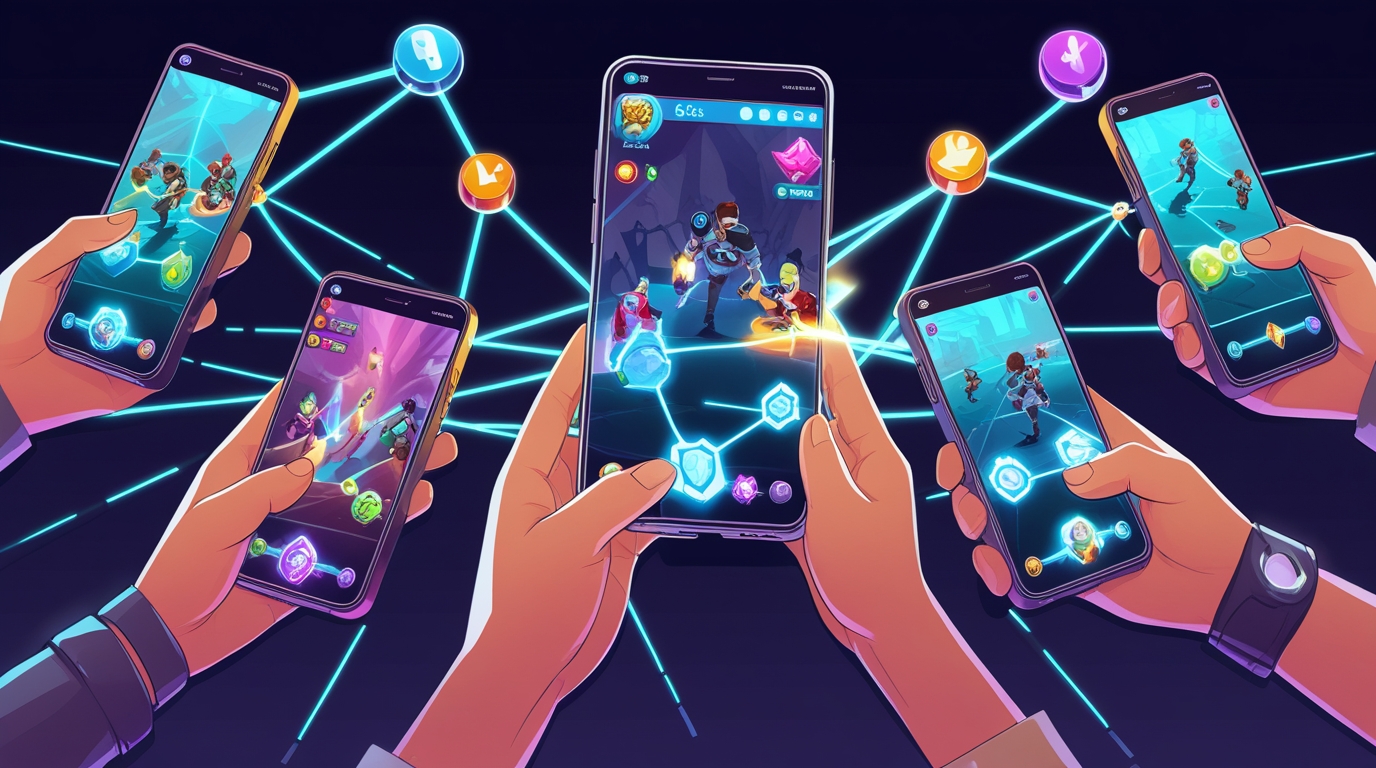
Multiplayer games dominate the mobile market. Entertainment has moved from the real world to the virtual world. Players increasingly expect to communicate, compete, and collaborate with others. But building a multiplayer mobile game is much more complex than building a single-player experience.
For studios and publishers planning a new game, understanding the development process early on can help avoid costly mistakes. Here, we will examine the core procedures for building a profitable multiplayer mobile game.
The secret of multiplayer games’ popularity
Players love multiplayer games because of the social connection: competing with friends and other strangers.
Multiplayer games offer several advantages: higher player retention and organic growth through social interaction. This type of connection also provides long-term monetization options through competitive modes, promotion systems, and events. However, these benefits also present technological and design obstacles that must be carefully considered from the start.
Step 1: Define the Multiplayer Experience
Before you begin development, it’s important to decide what type of multiplayer experience your game will offer. Some games, such as shooters, sports games, or war arenas, focus on player-to-player rivalry in real time, with players interacting simultaneously. Some games focus on cooperative gameplay, where players work together to complete tasks or overcome challenges to achieve common goals.
Asynchronous multiplayer is another well-liked kind. In this model, players influence each other’s progress without having to be online at the same time. Turn-based matches, ghost racing systems, and leaderboard competitions are examples of this structure.
Each approach affects both technical architecture and development cost, which is why defining the multiplayer format early is one of the most important design decisions.
Step 2: Choose the Right Network Architecture
There are two main models of the network architecture: client-server and peer-to-peer.
Most modern mobile multiplayer games rely on a client-server model. In this structure, a central server controls the gameplay logic, synchronizes players, and verifies actions. It simplifies the use of matchmaking systems, reduces the likelihood of cheating, and allows creators to better control the game’s balance.
On the other hand, peer-to-peer networks allow players to connect directly with one another without requiring a dedicated server to run the game. This approach may save on infrastructure costs, but the benefits are offset by the fact that such an approach cannot guarantee stability, equality, and security.
Step 3: Build a scalable backend
The technical basis of each multiplayer game is the backend system. It oversees leaderboards, events, player authentication, matchmaking, player statistics, and session management.
A game’s backend needs to accommodate more players at once as it expands. Games that are popular may sometimes accommodate thousands or even millions of players concurrently. Because of this, many developers rely on cloud infrastructure, which allows servers to automatically scale based on demand. This flexibility ensures stable operation during peak hours or special events.
Step 4: Design Fair and Stable Matchmaking
Matchmaking has a huge impact on player satisfaction. When matches feel unfair or unbalanced, players often leave the game quickly.
A good matchmaking system takes several factors into account. Player skill levels are usually the most important parameter, but other elements also matter, including geographic region, network latency, team composition, and recent match history. By combining these factors, developers can create balanced matches that feel competitive and rewarding.
Step 5: Optimize for Mobile Performance
Multiplayer games must minimize network traffic and optimize data synchronization. Mobile devices operate under strict performance and network constraints. Players may switch between networks, move between locations, or use devices with very different hardware capabilities. Efficient communication between the server and client reduces latency and ensures fast gameplay response.
Systems for restoring communication after a loss of connection are necessary to ensure uninterrupted operation.
Step 6: Plan real-time operations
The development of multiplayer games is rarely complete at launch. In fact, it is the beginning of a long-term service.
Introducing seasonal events, new game modes, and content updates keeps the community active. Competitive ranking systems and balance adjustments create new revenue streams.
Work with an experienced team to succeed
Developing multiplayer games requires knowledge of network technologies, backend systems, game design, and real-world operations.
At Melior Games, we help studios and companies create multiplayer mobile games from concept to launch. Our team supports the entire development process. We handle multiplayer game design, server architecture, backend systems development, mobile optimization, and real-world operations planning.
Our team can help you develop a scalable and reliable game that will attract players from all over the world.
Typical Mistakes in Multiplayer Game Development
Understanding risks early on helps studios reduce costs and prevent technical failures.
1. Underestimating the complexity of network technologies. Multiplayer game synchronization, latency handling, and server communication require specialized engineering expertise. Teams that treat multiplayer game development as a standard single-player project often encounter significant technical issues later.
2. Ignoring scalability. Without a scalable server architecture, servers can quickly become unstable during peak hours or during special events.
3. Poor matchmaking design. If players are constantly up against opponents who are either much stronger or significantly weaker, the experience quickly becomes monotonous.
4. Security. Without proper server testing and anti-cheat systems, competitive multiplayer games are vulnerable to exploits.
5. Inadequate planning for actual operations. Multiplayer games require updates, new content, and adjustments to the balance. Without a long-term content strategy, even technically flawless games can quickly lose players.
Avoiding these mistakes requires both technical expertise and strategic planning from the very beginning of the project.
How much does it cost to create a multiplayer mobile game?
The cost of developing a multiplayer mobile game largely depends on the complexity of the gameplay, the type of multiplayer interaction, and the scale of the server infrastructure.
A relatively simple asynchronous multiplayer game, such as turn-based matches or leaderboard competitions, may vary from $40,000 to $80,000. Such projects have simpler server logic and lower infrastructure requirements.
Real-time multiplayer games, PvP titles, or cooperative action games may have a budget of $80,000 – $200,000. The amount can vary depending on the game systems, artistic production, and scalability of the backend.
Projects that include advanced social features, live events, or large-scale online modes can exceed these ranges, as they require more powerful infrastructure, constant server maintenance, and support for live operations.
Work with an experienced development studio
An experienced development studio helps control these costs by designing the architecture correctly from the start and avoiding costly technical revisions later.
At Melior Games, we help clients carefully plan multiplayer projects, starting with proof of concept and technical architecture. This approach ensures that the game infrastructure, game systems, and monetization features meet the project’s goals and budget.
Our team can assist you with budgeting for development expenses, scoping, and transforming your idea for a multiplayer game into an engaging and scalable product.


