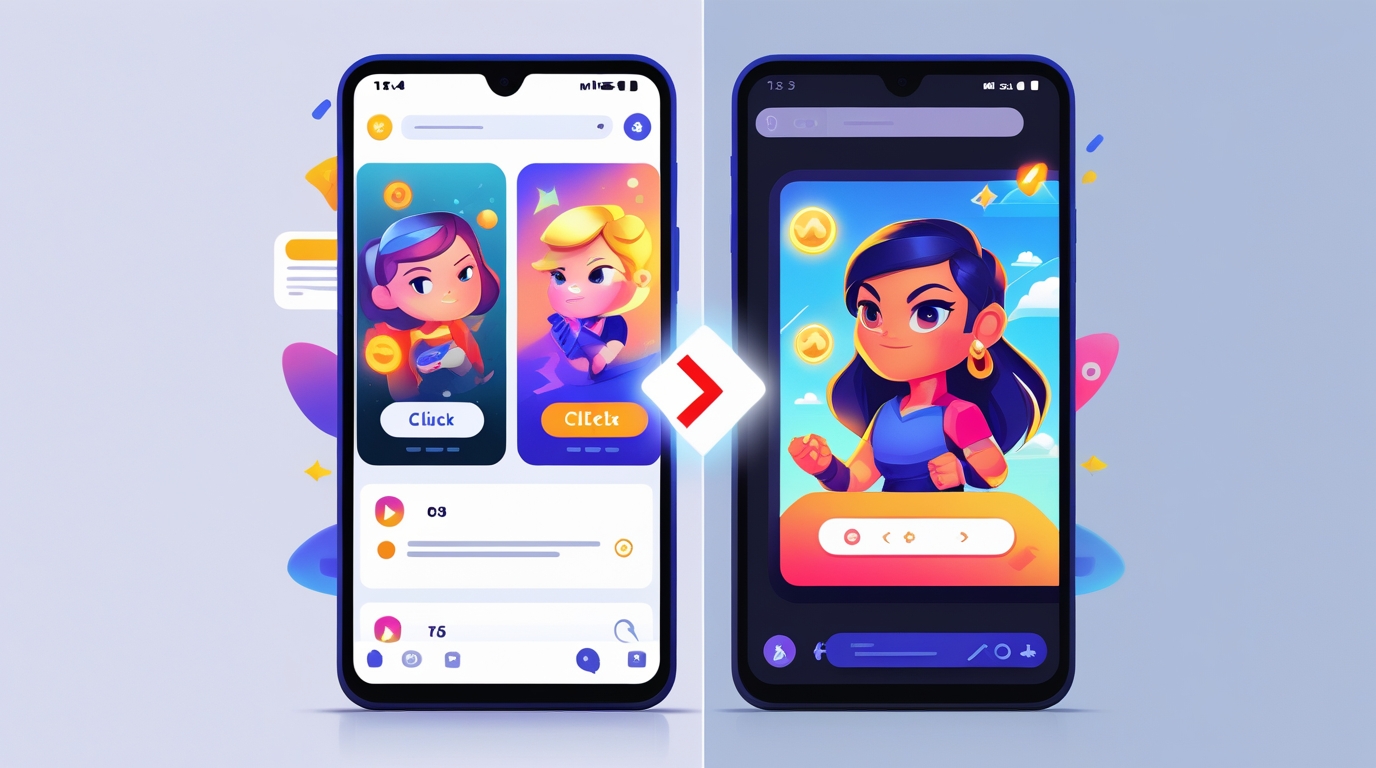
Why your visuals decide whether players install—or scroll past
In the mobile games market, player acquisition begins long before gameplay. It starts with a single impression: an ad, an app store icon, or a screenshot. In that moment, players make a split-second decision—tap or ignore.
Art style is at the center of that decision.
A well-chosen visual direction doesn’t just make a game look good—it directly impacts click-through rates (CTR), install rates, and overall marketing efficiency. In many cases, art style determines whether your game even gets a chance to be played.
First Impressions Are Purely Visual
Before players experience mechanics, progression, or monetization, they see visuals.
In user acquisition campaigns:
- Ads compete for attention in crowded feeds
- Screenshots must communicate gameplay instantly
- Icons must stand out at small sizes
This means your art style must:
- Be recognizable at a glance
- Communicate genre and tone instantly
- Trigger curiosity or emotion
If your visuals fail here, even the best-designed game will struggle to acquire users.
Art Style as a Marketing Tool
Art style is not just a creative decision—it’s a marketing strategy.
Different styles attract different audiences:
- Bright, stylized, exaggerated visuals
→ Work well for casual and hypercasual audiences - Clean, minimalistic UI-driven styles
→ Perform well in puzzle and logic games - Detailed, semi-realistic visuals
→ Appeal to midcore and strategy players - Dark, atmospheric styles
→ Target niche or genre-specific audiences
Choosing the wrong style can mean targeting the wrong audience—or no audience at all.
Stop Scrolling
On platforms where users scroll quickly, your game has less than a second to be seen.
High contrast, bright colors, clear silhouettes, and readable shapes will help your game stand out. Focusing on a single action or moment and keeping visual noise to a minimum will also help, as overly complex or muted visuals are often ignored. Not because they’re bad, but because they’re not optimized to capture attention.
Ad-Gameplay Alignment
One of the biggest mistakes in mobile marketing is a mismatch between your ad’s visuals and the actual gameplay.
You’ll get high install rates, but low retention. Disappointed players will churn quickly, so your acquisition budget won’t pay off.
Trust is a critical part of engagement, and visuals are where it all starts.
- Make sure your drawing style reflects real gameplay
- Use real game assets in your ads
- Maintain visual consistency across all channels
The Role of Characters in Customer Engagement
Characters are the face of your game.
Increasing brand awareness, fostering emotional connection, and boosting ad engagement are just a few benefits of having well-designed characters.
Even simple characters can outperform complex ones if they are instantly readable and expressive. Effective characters have clear, memorable silhouettes that match the tone and audience of the game.
Genre Expectations and Visual Language
Players link particular genres with particular visual styles.
For example:
- Match-3 games → colorful, glossy graphics
- Strategy games → detailed maps, units, and UI layers
- Idle game modes → clear, readable progression systems
It is possible to defy these assumptions, but only if it is done on purpose. If players can’t quickly understand what your game is about, they won’t install it.
Localization through Art Style
In 2026, global markets will demand visual adaptability.
Art style can impact performance across regions.Vibrant and exaggerated images are preferred by some markets. Others react more favorably to simple, minimalistic designs. Cultural references in design can improve engagement.
Regionalized creatives and A/B testing across markets can help drive better overall engagement performance.
Balancing performance and quality
High-quality visuals aren’t always better for engagement. With the sheer number of devices and OS types, game developers can’t rely on all players having the most powerful devices to play on. On mobile, faster loading speeds improve conversions. It’s also worth considering that on a relatively small screen, simpler visuals often translate better in advertising.
The objective is maximum efficiency and clarity, not maximal detail.
A/B testing design styles
Even the best studios shouldn’t rely solely on intuition. Design style can and should be tested using ad creatives and different visual directions.
Sometimes, a small change (color palette, facial expression, clarity of the user interface) can significantly increase CTR.
Common mistakes that hurt customer engagement
- Overly thought-out or cluttered visual elements
- Lack of visual focus in advertising
- Inconsistent style of different assets
- Poor readability on small screens
- Following trends without understanding the audience
How Melior Games Approaches Art to Engage Users
At Melior Games, art direction is closely tied to the user engagement strategy.
We specialize in:
- Developing visuals that work in a real-world marketing environment
- Aligning design style with target audience expectations
- Testing and iterating based on performance data
- Ensuring consistency between advertising and gameplay
Our goal is to create games that look great, converting viewers into players.
Final Thoughts
Art style is the first conversation your game has with the player. In a market where attention spans are limited and competition is fierce, visuals need to communicate, engage, and convert.
Successful design is strategic.
🚀 Let’s Design a Game That Installs
If you’re developing a mobile game and want visuals that deliver real engagement results, Melior Games can help you create a design style that stands out and works.
From concept to launch, we develop games with both players and market realities in mind.


